
Escape Into Night
Tony Steele recalls the terror of the 1972 children’s TV show
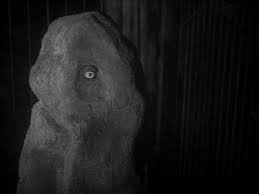

When those of a certain age gather, and the conversation turns to stuff we saw on telly when we were little – mentioning such classics as The Tomorrow People, Timeslip, and Ace of Wands (and insisting that Pertwee was much better than the silly chap with the scarf) – a nervous silence always falls, until somebody says, “Who remembers the one with the stones – the stones with eyes?”
Its title, which most people seem to have blanked from memory, is Escape Into Night, broadcast by ATV in April and May of 1972 – a truly underpants-soiling, six-part weekly teatime serial that everyone who was a kid at the time still has at the back of all their recurring nightmares. And if online discussions of it are anything to go by, this is no mere hyperbole, but often quite literally the case. It kick-started a minor trend of setting children's TV fantasy amid spooky megaliths, such as Children of the Stones (1977), filmed at Avebury (creditable, but very tame by comparison), the Doctor Who story The Stones of Blood (1978), filmed at the Rollrights (silly chap with scarf), and Quatermass (1979) filmed at a fake Stonehenge (“Huffity, Puffity, Ringstone Round…”).
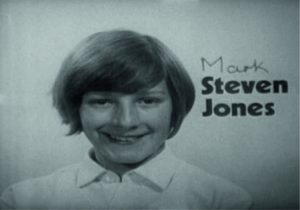
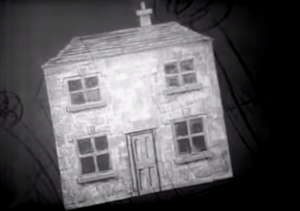
Yet Escape Into Night is not set at any ancient stone circle, but rather in the dreamscape world of its protagonist, Marianne, who, while poorly in bed for weeks on end, draws pictures in her colouring book that come to life as she sleeps. (Yes, this really is a case of, “…and then I woke up and it was all a dream.” Or is it?) There, she meets Mark, who can't walk, and is trapped in an empty house she has drawn. One night they argue, and in a fit of childish pique she draws eyes on standing stones surrounding the house, to keep Mark a prisoner, and from there the story unfolds.
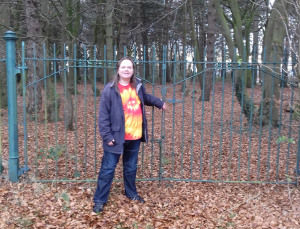
Mark was played by 13-year-old Steven Jones, a pupil at Moseley Modern, who was selected for the part by Alan Coleman, producer of Escape Into Night, with the help of his brother, Rick Coleman, member of staff at Moseley Modern 1964–1968, 1972–1974, and Moseley School 1974–1979. Marianne, meanwhile, was played by 11-year-old Vikki Chambers, a pupil at Tudor Grange Grammar School for Girls. All the location shots were filmed at Barr Beacon, itself no stranger to ghostly folklore and weird goings on. Escape Into Night is a faithful adaptation of the 1958 novel Marianne Dreams by Catherine Storr, now regarded as a children's classic, which was later adapted for the big screen, much more loosely (and far less successfully, in my opinion) in 1988 as Paperhouse, and in 1999, by the author herself, as an opera. Sadly, Catherine Storr committed suicide in 2001 aged 87. Alan Coleman, after moving to Australia in 1974, went on to produce The Young Doctors, Prisoner: Cell Block H, and Neighbours, among others, before passing away in 2013, aged 76.
Escape Into Night was made in colour, though as with so much else from that era, the original masters have been junked, and only black and white recordings survive. But, since most people in 1972 still had a black and white TV, this is exactly how they saw it (the stones' eyes were lit with a sickly green glow, for those who really want to know). It was released by Network DVD in 2009.
Of all the adaptations, this is surely the only one in which the stones sound like demented Daleks, balefully screaming “Not the light! Not the light!” as the lighthouse beam strikes them (you'll have to watch it). Seeing it again, after all these years, I suddenly felt profoundly sorry for them, conjured into existence for no apparent reason, not knowing who or what they were. No wonder they were scared. After filming, Alan Coleman kept the stones at his home in Walsall, but what happened to them when he emigrated to Australia remains a mystery.